
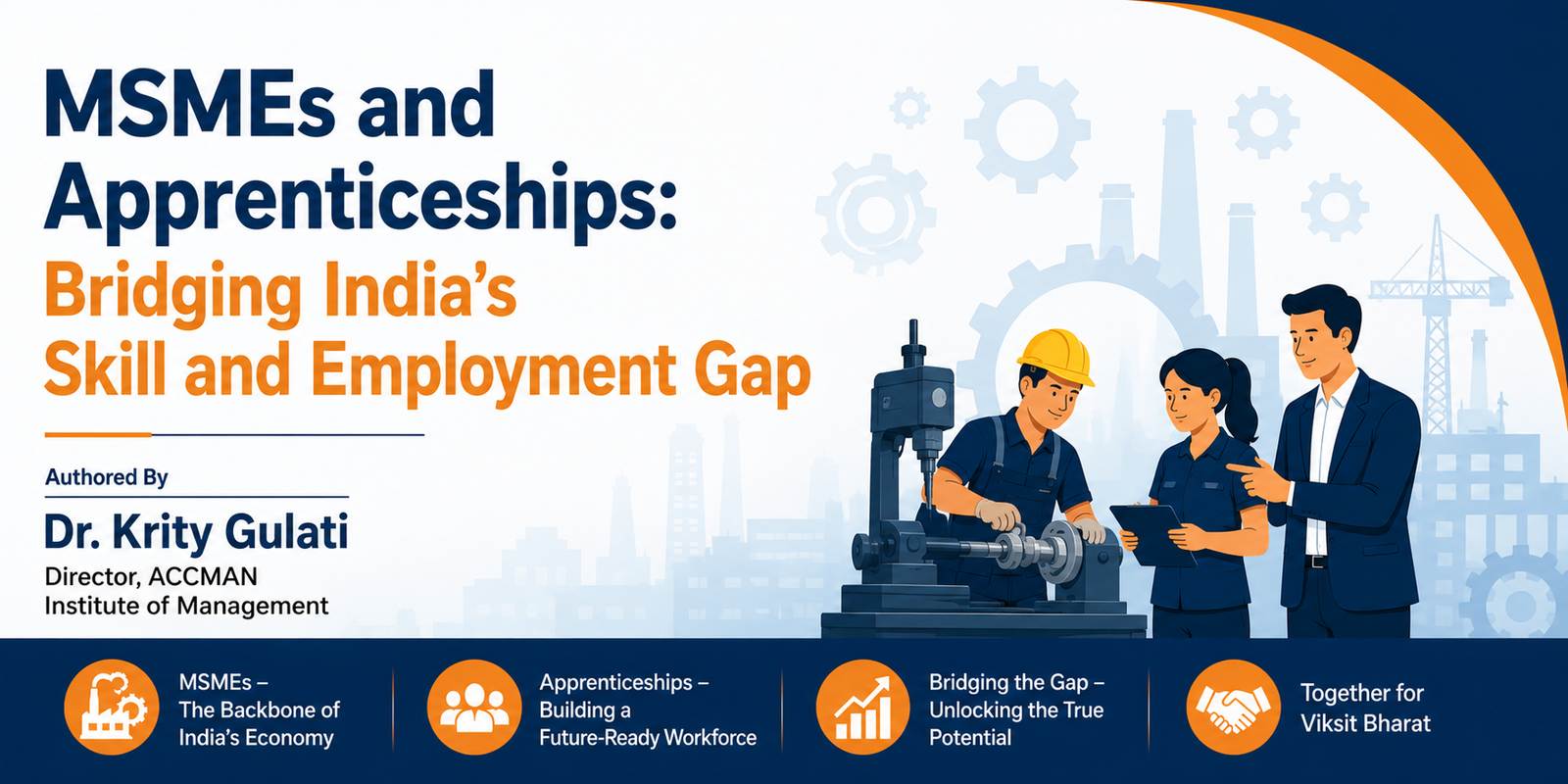
India stands at a critical inflection point in its workforce transformation journey. With over 65% of its population in the working-age group and nearly 12 million youth entering the labour market annually, the challenge is no longer just job creation, but job-readiness. Apprenticeships, long recognized globally as a bridge between education and employability, are emerging as a central pillar in India’s skilling architecture. The recent consultative push by the Ministry of Skill Development and Entrepreneurship (MSDE) to scale apprenticeship adoption within Micro, Small and Medium Enterprises (MSMEs) reflects a strategic shift from policy formulation to execution at scale.
Apprenticeships and the Structural Challenge of Employability
India’s skilling paradox is well documented. According to estimates by NITI Aayog and the International Labour Organization, only about 4–5% of India’s workforce has received formal skill training, compared to 50–75% in countries like Germany and South Korea. Simultaneously, industry reports suggest that less than 50% of graduates are immediately employable in high-productivity sectors.
This disconnects stems from a weak linkage between formal education and industry needs. Apprenticeships offer a practical solution by embedding “learning by doing” within real work environments. Countries with strong apprenticeship ecosystems, such as Germany’s dual system, demonstrate significantly lower youth unemployment rates and higher productivity outcomes.
MSMEs: The Missing Link in India’s Apprenticeship Expansion
India’s MSME sector contributes nearly 30% to GDP and employs over 110 million people, making it the backbone of the economy. Yet, its participation in apprenticeship programs remains disproportionately low. While schemes like the National Apprenticeship Promotion Scheme (NAPS) have expanded the overall apprenticeship base, engagement is still concentrated among large enterprises.
This imbalance is not accidental. Research from the Observer Research Foundation and World Bank highlights several structural barriers:
- Compliance Complexity: MSMEs often lack dedicated HR or compliance teams to navigate apprenticeship regulations.
- Low Awareness: Many small enterprises remain unaware of incentives, subsidies and simplified processes.
- Perceived Cost Burden: Despite government stipends, MSMEs view apprenticeships as an additional financial and administrative responsibility.
- Informality of Operations: A large proportion of MSMEs operate in semi-formal or informal settings, making structured training integration challenging.
The recent MSDE consultations rightly identify that without integrating MSMEs into the apprenticeship ecosystem, India cannot achieve scale.
Policy Innovation: From Fragmentation to Cluster-Based Models
One of the most promising approaches discussed is the adoption of Group Training Organizations (GTOs), a model successfully implemented in countries like Australia. Under this framework, a central entity manages recruitment, training and compliance, while multiple MSMEs share apprentices.
This cluster-based approach aligns well with India’s industrial geography, where MSMEs often operate in localized clusters such as textiles in Tiruppur, auto components in Pune, or handicrafts in Moradabad. By reducing administrative burden and enabling shared resources, GTOs can significantly lower entry barriers.
Similarly, integrating apprenticeship pathways with higher education through programs like Apprenticeship Embedded Degree Programmes (AEDPs) and Work-Integrated Learning Programmes (WILPs) addresses another structural gap. According to the All India Council for Technical Education, industry-integrated degree models can improve employability outcomes by up to 30–40% compared to traditional classroom-based education.
Inclusion, Equity and the Future of Work
A notable dimension of the policy push is its emphasis on inclusion. Expanding apprenticeship opportunities for women, Persons with Disabilities (PwDs) and marginalized communities is not merely a social objective but an economic necessity. The International Monetary Fund estimates that increasing female labour force participation alone could add significant percentage points to India’s GDP.
Digital and virtual apprenticeships, also discussed in the consultations, open new avenues for inclusion, especially in remote and underserved regions. Hybrid models combining online theoretical training with localized practical exposure can democratize access to skill development.
Strategic Policy Recommendations
To translate intent into impact, India’s apprenticeship strategy must move along five key policy axes:
1. Regulatory Simplification and Digital Integration: A single-window digital platform integrating registration, compliance and monitoring can reduce friction for MSMEs. The success of platforms like Udyam Registration demonstrates the power of simplified digital governance.
2. Financial Incentivization and Risk-Sharing: Enhanced stipend support, tax incentives and social security coverage for apprentices can make participation economically viable for MSMEs. Public-private cost-sharing models should be expanded.
3. Sector-Specific Skill Councils and Industry Ownership: Greater involvement of Sector Skill Councils in designing apprenticeship curricula can ensure alignment with evolving industry needs, particularly in emerging sectors like green energy, semiconductors and AI.
4. Awareness and Behavioral Change Campaigns: Large-scale outreach through industry associations such as Confederation of Indian Industry and Federation of Indian Chambers of Commerce and Industry is essential to shift perceptions and build trust among MSMEs.
5. Data-Driven Monitoring and Outcome Measurement: Robust data systems must track not just enrollment, but completion rates, employment outcomes and wage progression. This will ensure accountability and continuous policy refinement.
Towards a Viksit Bharat Workforce
India’s aspiration to become a developed nation by 2047, often articulated as the Viksit Bharat vision, hinges on its ability to transform demographic potential into productive capability. Apprenticeships offer a scalable, market-aligned and inclusive pathway to achieve this transformation.
The recent policy momentum led by MSDE signals a recognition that the next phase of India’s skilling journey must move beyond schemes to systems, beyond intent to implementation. By placing MSMEs at the centre of this transformation, India is not only addressing its employment challenge but also strengthening the competitiveness of its industrial base.
If executed effectively, this shift could mark the transition from a degree-driven economy to a skill-driven one, where learning and earning are not sequential, but simultaneous.




testing comment