
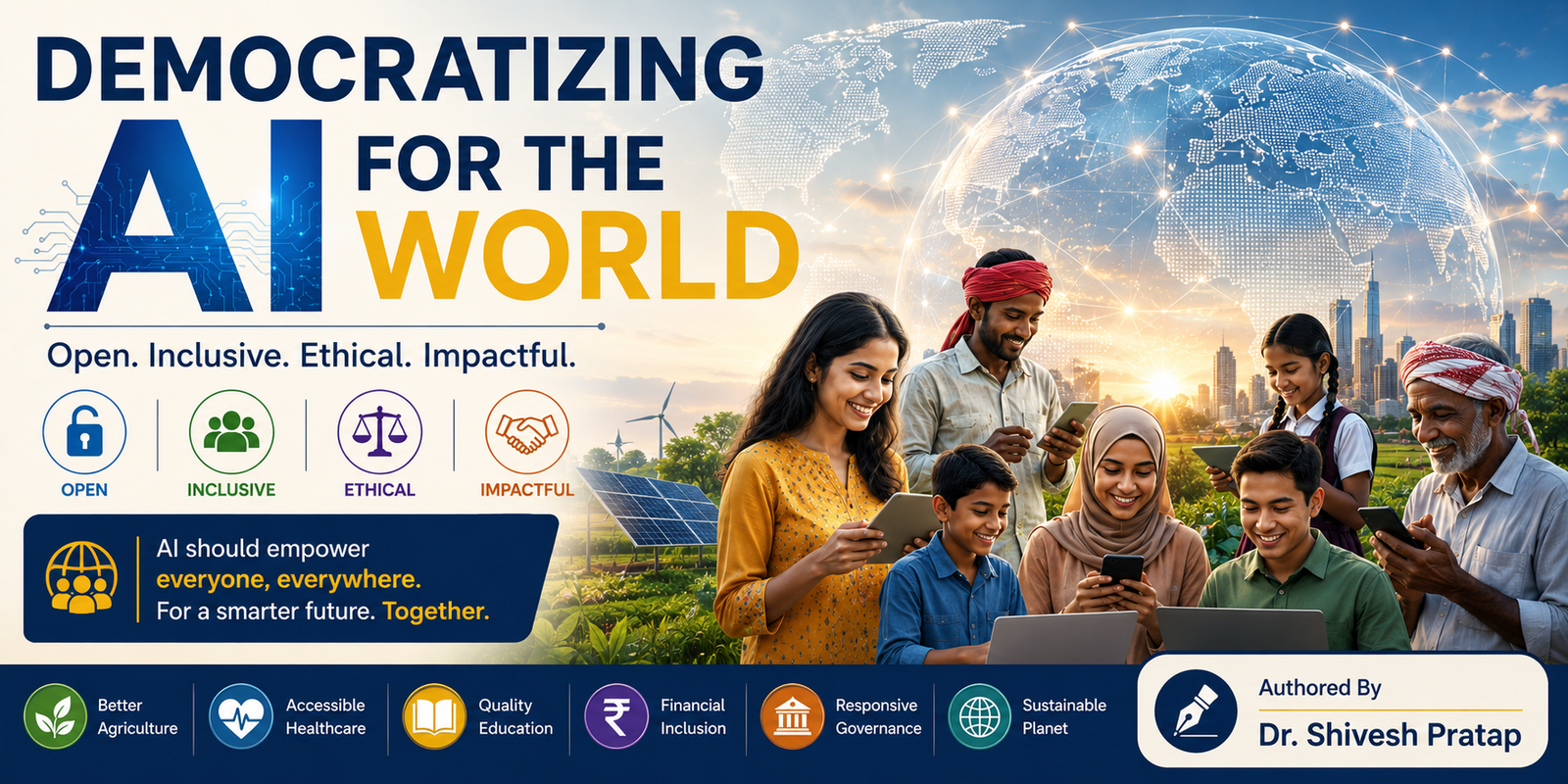
In the contemporary technological discourse, Artificial Intelligence (AI) is no longer merely an emerging tool, it has become a defining force shaping economies, governance models, and everyday life. From consumer applications to complex policy frameworks, AI is now omnipresent. Yet, as its influence grows, so does a critical concern, who controls AI, who benefits from it, and who is left behind? Against this backdrop, the India AI Impact Summit 2026, inaugurated by Narendra Modi in New Delhi, represents a fundamental shift in the global AI conversation, from concentration to democratization, from elite access to inclusive impact.
Held from 16–20 February 2026 under the umbrella of the IndiaAI Mission, the Summit has been widely described as the most consequential AI gathering ever hosted for the Global South. But more importantly, it reflects India’s civilizational ethos of Vasudhaiva Kutumbakam, the world as one family, translated into a 21st-century technological framework.
The Global AI Imbalance: Why Democratization Is Urgent
The global artificial intelligence ecosystem remains sharply concentrated, reinforcing structural inequalities in technological access and influence. Evidence from the OECD AI Policy Observatory (2024) and the Stanford AI Index Report (2025) indicates that more than 70 percent of large-scale AI foundation models originate in just two countries, the United States and China, while nearly 80 percent of global private AI investment is concentrated in fewer than ten nations. High-income economies collectively command over 85 percent of global AI venture capital funding, underscoring the capital-intensive and geographically skewed nature of current AI development. This concentration stands in stark contrast to global demographic realities: the United Nations’ World Population Prospects (2024) confirms that approximately 85 percent of the world’s population resides in developing and emerging economies, yet these regions account for only a marginal share of AI infrastructure, research capacity, and model development.
Patent data further illustrates this imbalance, with the World Intellectual Property Organization (2024) reporting that more than 75 percent of AI-related patents originate from the United States, China, Japan, and South Korea alone. At the same time, digital access remains uneven, as the International Telecommunication Union (2024) estimates that over 2.6 billion people worldwide are still offline, severely limiting their ability to participate in or benefit from AI-driven systems. Institutional readiness is equally constrained; UNESCO’s AI Readiness Assessment (2023) reveals that fewer than 20 percent of low-income countries have articulated a national AI strategy. Together, these indicators highlight a widening global AI divide, one that forms the empirical foundation of India’s position at the India AI Impact Summit 2026: artificial intelligence must transition from a model of concentration and exclusivity to one of democratization, shared access, and inclusive development.
Democratization of AI: India’s Global Thesis
At the heart of the Summit lies India’s central thesis, AI must be democratized. In the Indian context, the democratization of artificial intelligence is conceived as a multidimensional process that goes beyond mere technological diffusion. At its core lies the principle of affordable access, ensuring that AI tools remain cost-effective and usable for small enterprises, farmers, students, startups, and local governments rather than being confined to large corporations or advanced economies. Equally central is the creation of open ecosystems, where open data platforms and open-source AI models lower entry barriers, foster innovation, and prevent excessive concentration of technological power. India also emphasizes collaborative innovation through cross-border research partnerships, particularly among Global South nations, recognizing that shared challenges such as climate resilience, healthcare access, and agricultural productivity demand context-specific solutions developed through collective knowledge. Finally, India advocates ethical governance frameworks that are principle-based rather than uniform and prescriptive, allowing AI regulation to respect cultural, economic, and developmental diversity while upholding core values of fairness, accountability, and social trust.
This approach challenges the prevailing assumption that AI leadership belongs exclusively to a handful of advanced economies. India argues that moral and practical legitimacy in AI governance will increasingly come from those who use AI to solve humanity’s most urgent problems.
From Fear-Centric AI to Impact-Centric AI
Until recently, the global AI narrative was largely dominated by conferences in North America and Europe. These platforms often emphasized existential risks, over-automation fears, and regulatory anxieties as important discussions, but ones that frequently reflected the priorities of high-income, technologically saturated societies. For developing nations, however, the challenge is not excessive AI, but insufficient access to it.
India’s approach at the AI Impact Summit 2026 deliberately reframed the debate. Rather than asking “How dangerous can AI become?”, India posed a more grounded question: “How useful can AI be for the largest number of people on the planet?”
Nearly 85% of the world’s population lives in developing and emerging economies. Their most pressing challenges, healthcare access, agricultural productivity, climate resilience, quality education, financial inclusion and responsive governance, are precisely the domains where applied AI can deliver transformative gains. India’s argument is clear, the future of AI must be judged not by abstract capability benchmarks, but by real-world outcomes.
India as a Bridge Between Technology and Humanity
India brings an unparalleled combination of demographic depth and digital scale to the global artificial intelligence discourse, positioning it uniquely to translate AI into population-level impact. With a population exceeding 1.4 billion (UN World Population Prospects, 2024), India represents one of the world’s largest and most diverse real-world data ecosystems. This scale is reinforced by rapid digital adoption, with more than 950 million internet users as of 2025 (IAMAI Digital Report, 2025), making India the second-largest online population globally.
India’s leadership in digital public infrastructure is most visible in its payments architecture: the Unified Payments Interface (UPI) now processes over 12 billion transactions every month (Reserve Bank of India, 2025) and accounts for nearly 46 percent of all real-time digital payments worldwide (AACI Global Payments Report, 2024). Together with platforms such as Aadhaar and DigiLocker, UPI forms an interoperable Digital Public Infrastructure (DPI) stack that has been internationally examined and endorsed by the World Bank as a scalable and replicable governance model for developing economies (World Bank, Digital Public Infrastructure Report, 2024). This cumulative experience strengthens India’s central claim that artificial intelligence, when layered atop robust DPI frameworks, can move beyond elite and commercial applications to enable inclusive, citizen-centric development systems across the Global South.
The AI Impact Summit builds on this legacy. India is not advocating AI as a luxury product for advanced markets, but as a development multiplier, capable of amplifying limited resources and accelerating human potential. This philosophy aligns closely with the needs of the Global South, where constraints of capital, infrastructure, and skilled manpower are real, but where data, demand, and ingenuity abound.
The Three-Pillar Framework: People, Planet, Progress
At the conceptual core of the Summit lies a three-pillar framework, People, Planet, and Progress, which provides a holistic lens for evaluating AI deployment.
-
People: AI for Human Empowerment
Discussions under this pillar focused on education, employment, skilling, and social inclusion. India emphasized that AI should augment human capability rather than displace it. Use cases included adaptive learning systems for rural schools, AI-powered diagnostics to support frontline health workers, and language models trained in local languages to break digital barriers.
Importantly, workforce transition was a central theme. Rather than fearing job loss, India highlighted the opportunity for large-scale reskilling, especially in AI-assisted services, healthcare analytics, agri-tech, and governance technologies.
-
Planet: Intelligence for Sustainability
Climate change disproportionately affects developing nations. AI-driven climate modeling, smart irrigation, crop-yield prediction, disaster early-warning systems, and energy optimization were showcased as tools to build resilience. India’s message was unambiguous: sustainability and AI are not competing priorities—they are mutually reinforcing.
-
Progress: Responsible and Inclusive Growth
Under the Progress pillar, the focus shifted to innovation ecosystems, digital infrastructure, and ethical governance. India advocated open standards, interoperable platforms, and shared datasets, arguing that monopolistic AI models threaten innovation diversity. Responsible AI, in this view, is not about over-regulation but about shared norms, transparency, and accountability.
AI and Economic Impact:
The economic rationale for the democratization of artificial intelligence is increasingly supported by robust empirical evidence. Global projections suggest that AI is set to become a major driver of economic growth over the next decade. According to PwC (Global AI Study, 2023), AI could contribute as much as USD 15.7 trillion to the global economy by 2030, primarily through productivity gains, innovation, and consumption effects. At the national level, the McKinsey Global Institute (2023) estimates that AI adoption could add USD 450–500 billion to India’s GDP by 2030, underlining its potential as a critical growth engine for emerging economies. At the same time, the International Monetary Fund (Gen-AI and Economic Productivity Report, 2024) cautions that AI could affect nearly 40 percent of global jobs, with highly uneven outcomes across countries and sectors, making large-scale reskilling and workforce transition policies indispensable, particularly in the Global South.
Sector-level evidence further reinforces AI’s role as a development multiplier. In healthcare, studies published in Lancet Digital Health (2023) indicate that AI-assisted diagnostics can reduce misdiagnosis rates by 20–30 percent, while the World Health Organization estimates that AI-enabled screening and decision-support tools could expand access to diagnostic services by up to 50 percent in rural and underserved regions. In agriculture, the Food and Agriculture Organization (2024) reports that AI-driven precision farming techniques can increase crop yields by 15–20 percent while reducing water consumption by 20–30 percent, a critical advantage for climate-vulnerable economies. In education, evidence from the UNESCO (EdTech Report, 2024) shows that adaptive AI-based learning platforms can improve learning outcomes by 20–35 percent in low-resource environments. Taken together, these findings demonstrate that for Global South economies facing chronic shortages of doctors, agricultural extension workers, and trained teachers, AI does not merely automate tasks, it multiplies scarce human resources, enabling faster, broader, and more equitable delivery of essential services.
AI Infrastructure and Strategic Autonomy
The proposed USD 175 billion AI Data City near Visakhapatnam represents more than an infrastructure project; it reflects a strategic shift toward compute sovereignty and long-term technological autonomy. In the current global landscape, AI infrastructure remains highly concentrated. According to Synergy Research Group (2025), the United States hosts more than 40 percent of the world’s hyperscale data centers, reinforcing its dominance in cloud and high-performance computing capacity. At the same time, the International Data Corporation (IDC Global DataSphere Forecast, 2024) projects that global AI compute demand is expected to grow five to six times by 2030, driven by large language models, generative AI workloads, and enterprise-scale deployment.
Against this backdrop, India’s plan to develop large-scale GPU clusters, advanced data centers, and semiconductor-linked ecosystems is aimed at reducing structural dependence on foreign cloud monopolies while building domestic and regional AI capacity. The participation of major technology and industrial players such as Google and Reliance Industries signals an emerging alignment between private capital, digital infrastructure expansion, and national AI strategy. In strategic terms, the initiative positions India not merely as a consumer of global AI models, but as a future provider of shared compute infrastructure for the Global South.
Global AI Impact Challenge: Innovation from Everywhere
One of the Summit’s most distinctive features was the Global AI Impact Challenge. With over 4,650 AI solutions submitted from more than 60 countries, the challenge illustrated a powerful truth: innovation is not geographically constrained.
Seventy top solutions were selected for real-world deployment across healthcare diagnostics, climate adaptation, agriculture, education, governance, and financial inclusion. A notable emphasis was placed on women-led and youth-driven innovations, reinforcing India’s belief that diversity is not just ethical, it is strategic.
By focusing on deployment rather than mere demonstration, India sent a strong signal: AI success should be measured by adoption and impact, not by pitch decks or patents alone.
Vasudhaiva Kutumbakam in the Age of Algorithms
What truly differentiates India’s AI vision is its philosophical grounding. Vasudhaiva Kutumbakam is not invoked as a slogan, but as a policy compass. In practical terms, it means resisting techno-nationalism and advocating technological pluralism.
According to the OECD AI Policy Database (2025), more than 80 percent of formal AI regulatory frameworks currently originate from OECD economies, underscoring how global rule-making in artificial intelligence remains concentrated within advanced industrial nations. India’s approach, however, seeks to broaden this normative landscape by advancing a principle-based governance model rather than a prescriptive, compliance-heavy regulatory regime. Drawing conceptual alignment with the UNESCO Recommendation on the Ethics of Artificial Intelligence (2021), India emphasizes harm prevention, fairness, accountability, and transparency while deliberately avoiding regulatory overreach that could suppress innovation in emerging economies. This calibrated framework reflects the belief that governance must balance ethical safeguards with developmental flexibility. During its G20 Presidency in 2023, India foregrounded Digital Public Infrastructure as a tool for inclusive growth; the India AI Impact Summit 2026 builds upon that foundation by extending the DPI philosophy into the domain of algorithmic governance, positioning India as a bridge between innovation-driven growth and responsible AI stewardship.
India does not seek AI dominance; it seeks AI diffusion. By positioning itself as a facilitator rather than a gatekeeper, India aims to help shape global AI norms that are inclusive, development-oriented, and ethically grounded.
This stance resonates deeply with developing nations that fear being reduced to mere data providers or downstream consumers in the AI economy. India’s leadership offers an alternative path, one where shared growth replaces zero-sum competition.
For countries across Africa, Latin America, Southeast Asia, and the Middle East, the India AI Impact Summit 2026 offers more than inspiration, it offers a blueprint. It demonstrates that meaningful AI adoption does not require replicating Western models wholesale. Instead, it requires aligning technology with local priorities, capacities, and values.
India’s experience shows that scale, diversity, and complexity, often seen as obstacles, can become strengths when combined with thoughtful digital design and public-interest governance.
Redefining Global AI Leadership
The India AI Impact Summit 2026 marks a turning point in global AI discourse. It shifts the center of gravity from fear to function, from exclusivity to inclusion, and from speculative futures to present realities.
By foregrounding democratization, Global South solidarity, and problem-solving for common people, India is redefining what it means to be an AI leader. Leadership, in this vision, is not about who builds the largest models, but about who builds the most meaningful outcomes.
As AI continues to reshape the world, India’s message is both timely and timeless: technology achieves its highest purpose not when it dazzles, but when it serves humanity.



Leave a Reply